
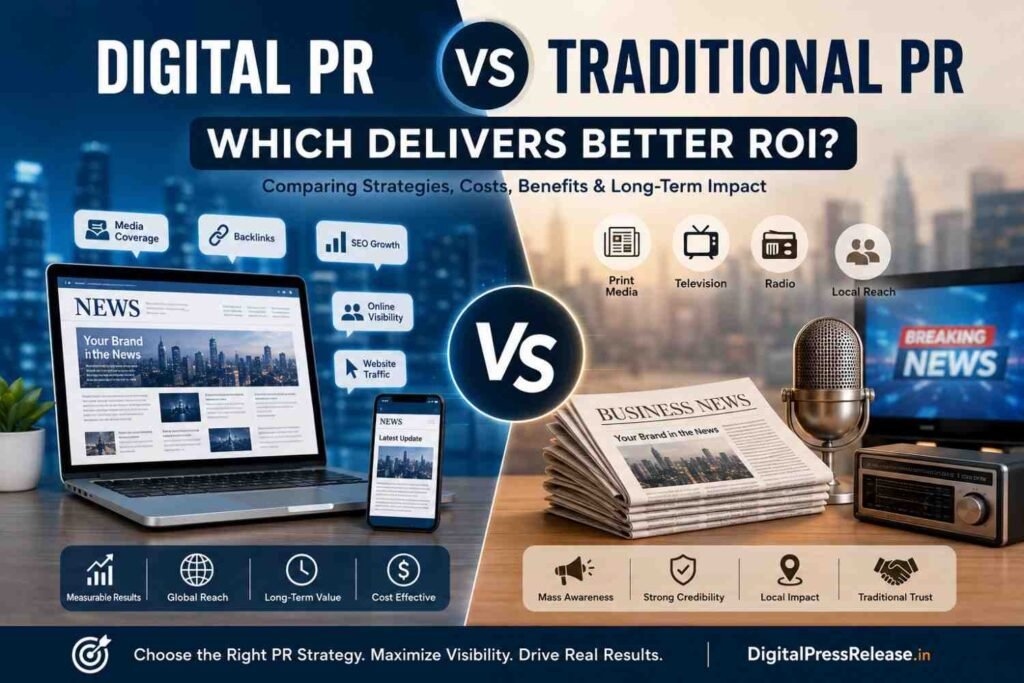
Public Relations has evolved dramatically over the last decade. While traditional PR once relied on newspapers, television, radio, and print magazines, today’s businesses operate in a digital-first environment where online visibility, search rankings, and brand credibility play a much larger role in growth.
This shift has made Digital PR one of the most effective strategies for startups, SaaS companies, enterprises, educational institutions, healthcare brands, and growing businesses looking to increase visibility and generate measurable business outcomes.
Yet many organizations still ask an important question:
Should we invest in Digital PR or stick with Traditional PR?
The answer depends on your business goals, audience, budget, and how you define return on investment (ROI).
In this guide, we’ll compare both approaches in depth, helping you understand where each excels and which delivers stronger long-term value.
What is Digital PR?
Digital PR is a modern public relations strategy focused on earning online media coverage, high-authority backlinks, brand mentions, and digital visibility through trusted news platforms, industry publications, blogs, and online magazines.
Unlike traditional PR, Digital PR integrates closely with SEO, content marketing, and digital branding, allowing businesses to improve both reputation and online discoverability.
Also read: How to Announce Startup Funding Through a Press Release: Complete Guide for Founders (2026)
Typical Digital PR Activities
- Online press release distribution
- Journalist outreach
- Digital media pitching
- Thought leadership articles
- Guest contributions
- Influencer collaborations
- Executive interviews
- Industry news features
- Podcast appearances
- Data-driven campaigns
The result is not only media exposure but also improved search engine performance, stronger domain authority, and sustained brand awareness.
What is Traditional PR?
Traditional PR focuses on building brand awareness through offline media channels such as newspapers, television, radio, magazines, and trade publications.
The primary objective is to enhance public perception, communicate company news, and build credibility among audiences that rely on conventional media.
Also read :Organic Editorial Coverage with Author/Journalist Byline (Non-Disclaimer): The Complete Guide
Common Traditional PR Activities
- Newspaper coverage
- TV interviews
- Radio appearances
- Print magazine features
- Press conferences
- Media events
- Corporate announcements
- Product launches
- Crisis communication
- Public speaking engagements
Traditional PR remains valuable for organizations targeting local communities, government bodies, or industries where offline credibility carries significant weight.
Digital PR vs Traditional PR: Key Differences
| Feature | Digital PR | Traditional PR |
|---|---|---|
| Primary Channels | Online news sites, blogs, digital publications | Newspapers, TV, radio, print magazines |
| Audience Reach | Global | Often regional or national |
| Measurability | Highly measurable | Limited measurement |
| SEO Benefits | Excellent | Minimal |
| Backlinks | Yes | No |
| Search Visibility | Improves Google rankings | Little direct impact |
| Analytics | Detailed and real-time | Difficult to track |
| Campaign Optimization | Continuous | Limited once published |
| Lead Generation | Strong | Moderate |
| Long-term Value | High | Moderate |
Why Businesses Are Shifting Toward Digital PR
Businesses increasingly prefer Digital PR because it offers measurable outcomes that align with modern marketing objectives. A single well-executed digital PR campaign can generate media coverage, authoritative backlinks, referral traffic, social shares, and improved search visibility—all from one initiative.
In contrast, while traditional PR can deliver broad awareness, it is often more difficult to measure its direct impact on website traffic, lead generation, or search performance.
Digital PR vs Traditional PR: Which Delivers Better ROI?
One of the biggest reasons businesses are moving toward Digital PR is its ability to produce measurable business outcomes. Unlike traditional PR, where success is often measured by estimated audience reach or media impressions, Digital PR provides clear performance metrics such as website traffic, backlink quality, keyword rankings, lead generation, social engagement, and conversions.
For marketing managers and business owners, this makes it much easier to understand whether a PR campaign is delivering value.
ROI Comparison: Digital PR vs Traditional PR
When evaluating return on investment (ROI), businesses should look beyond media exposure alone. A successful PR strategy should contribute to long-term business growth by improving visibility, credibility, and customer acquisition.
| ROI Factor | Digital PR | Traditional PR |
|---|---|---|
| Brand Awareness | ★★★★★ | ★★★★★ |
| SEO Benefits | ★★★★★ | ★☆☆☆☆ |
| Lead Generation | ★★★★★ | ★★☆☆☆ |
| Website Traffic | ★★★★★ | ★★☆☆☆ |
| Media Credibility | ★★★★★ | ★★★★★ |
| Measurable Results | ★★★★★ | ★★☆☆☆ |
| Long-Term Value | ★★★★★ | ★★★☆☆ |
| Local Brand Recognition | ★★★☆☆ | ★★★★★ |
| Cost Efficiency | ★★★★★ | ★★★☆☆ |
Key Takeaway
While Traditional PR remains effective for offline reputation and mass awareness, Digital PR typically delivers stronger long-term ROI because it creates assets that continue generating value long after a campaign ends.
For example, an online news article featuring your business can:
- Rank in Google search results
- Drive referral traffic for months or years
- Earn high-quality backlinks
- Improve domain authority
- Increase brand trust
- Support future SEO efforts
A newspaper advertisement or TV interview may create immediate visibility, but its impact is often short-lived unless supported by digital amplification.
Cost Comparison: Which Is More Budget-Friendly?
Budget plays a significant role when choosing between Digital PR and Traditional PR. Although pricing varies depending on campaign objectives, Digital PR generally offers greater flexibility and scalability.
| Expense Category | Digital PR | Traditional PR |
|---|---|---|
| Press Release Distribution | Moderate | Moderate |
| Journalist Outreach | Included in many campaigns | Included |
| Newspaper Advertising | Not required | Often expensive |
| TV Advertising | Optional | High cost |
| Print Production | Not required | Required |
| Campaign Tracking | Included | Limited |
| SEO Value | High | Minimal |
Why Digital PR Often Delivers Better Value
Digital PR campaigns continue working even after publication. Every quality backlink, media mention, or search engine ranking contributes to ongoing visibility without requiring continuous investment.
Traditional PR campaigns often require repeated spending to maintain visibility, particularly when relying on print advertisements or broadcast media.
Real-World Example
Imagine two technology startups launching similar products.
Company A: Traditional PR
The company secures a feature in a leading business newspaper and participates in a local television interview.
Results:
- Strong short-term awareness
- Limited online discoverability
- Minimal SEO improvement
- Difficult to measure direct conversions
Company B: Digital PR
The company distributes a press release through reputable online news platforms, earns mentions in technology publications, secures guest articles, and gains backlinks from authoritative websites.
Results:
- Increased organic website traffic
- Improved keyword rankings
- Higher domain authority
- Better lead generation
- Ongoing referral traffic
- Long-term online visibility
Although both companies receive media attention, Company B continues benefiting from its Digital PR campaign long after the initial publication.
Which Businesses Benefit Most from Digital PR?
Digital PR is particularly effective for organizations that depend on online visibility and customer acquisition.
Ideal for:
- SaaS companies
- Technology startups
- E-commerce brands
- Healthcare organizations
- Educational institutions
- Professional service firms
- B2B companies
- Financial services
- Real estate businesses
- Growing startups seeking investor visibility
For these businesses, Digital PR not only strengthens brand credibility but also supports search engine optimization, making it easier for potential customers to discover them online.
When Traditional PR Still Makes Sense
Despite the rise of Digital PR, Traditional PR remains valuable in several situations.
It is often the right choice when your goal is to:
- Reach audiences with strong print media consumption
- Build credibility through national newspapers
- Engage government stakeholders
- Promote major public events
- Support political or public affairs campaigns
- Strengthen local community awareness
- Launch large-scale corporate announcements
Traditional media continues to carry significant authority, particularly for organizations targeting audiences that rely on television, radio, and print publications.
Expert Insight
The most successful organizations no longer view Digital PR and Traditional PR as competing strategies. Instead, they integrate both approaches to maximize reach and impact.
For example, a company launching a new product might:
- Announce the launch through a traditional media event.
- Distribute a digital press release to online news portals.
- Publish thought leadership articles.
- Share media coverage across social platforms.
- Leverage backlinks to improve SEO.
- Repurpose media mentions into website content and email campaigns.
This integrated approach creates stronger brand visibility across both online and offline channels while delivering measurable business outcomes.
Soft CTA
If your goal is to improve search visibility, media credibility, and lead generation, Digital PR should be a core part of your marketing strategy. A well-planned campaign can help your business reach the right audience while building long-term authority.
Common Myths About Digital PR and Traditional PR
As businesses evaluate their public relations strategy, several misconceptions can lead to poor decisions. Understanding these myths helps organizations invest in the right channels and set realistic expectations.
Myth 1: Digital PR Is Only for Large Companies
Reality: Digital PR is highly scalable and can benefit businesses of all sizes. Startups, SMEs, educational institutions, SaaS companies, and local businesses can all gain visibility through well-planned digital PR campaigns. In fact, smaller businesses often achieve significant exposure by targeting niche publications and industry-specific media.
Myth 2: Traditional PR Is Obsolete
Reality: Traditional PR still plays an important role in industries where offline credibility matters. National newspapers, television interviews, and trade publications continue to influence decision-makers, investors, policymakers, and local communities.
The key is knowing when to use it rather than replacing it entirely.
Myth 3: Publishing One Press Release Is Enough
Reality: Effective PR is an ongoing process, not a one-time activity.
Consistent campaigns help businesses:
- Stay visible in the media
- Build stronger brand recognition
- Increase journalist relationships
- Improve search visibility over time
- Reinforce trust with customers
A regular PR strategy creates momentum that a single announcement rarely achieves.
Myth 4: PR Doesn’t Impact SEO
Reality: This is one of the biggest misconceptions.
High-quality Digital PR campaigns can contribute to SEO by:
- Earning authoritative backlinks
- Increasing branded searches
- Driving referral traffic
- Improving topical authority
- Supporting content marketing
- Strengthening online trust signals
When integrated with SEO, Digital PR becomes a powerful driver of long-term organic growth.
Common Mistakes Businesses Make
Even with the right PR strategy, certain mistakes can reduce campaign effectiveness.
1. Choosing PR Based Only on Cost
The cheapest option isn’t always the most effective. Businesses should evaluate:
- Media network quality
- Publication relevance
- Industry expertise
- Reporting capabilities
- Long-term value
A lower-cost campaign with limited reach may produce weaker results than a strategic campaign targeting the right audience.
2. Focusing Only on Media Mentions
Many organizations celebrate media coverage but overlook what happens next.
Instead, evaluate:
- Website traffic
- Lead generation
- Search rankings
- Backlink quality
- Social engagement
- Brand mentions
- Conversion rates
These metrics provide a more complete picture of campaign success.
3. Ignoring Content Quality
A compelling story is far more likely to attract journalists than a promotional announcement.
Successful PR content should:
- Address industry trends
- Offer expert insights
- Present original data
- Solve audience problems
- Highlight meaningful achievements
Quality storytelling is often the deciding factor in securing valuable media coverage.
4. Not Defining Campaign Objectives
Before launching any PR initiative, define what success looks like.
Possible goals include:
- Building brand awareness
- Generating qualified leads
- Increasing website traffic
- Launching a new product
- Improving investor confidence
- Supporting recruitment
- Managing brand reputation
Clear objectives make it easier to measure ROI and refine future campaigns.
Best Practices to Maximize PR ROI
Whether you choose Digital PR, Traditional PR, or a hybrid approach, following these best practices can improve campaign performance.
Create Newsworthy Stories
Journalists receive countless pitches every day. Focus on stories that provide genuine value, such as:
- Industry research
- Product innovations
- Company milestones
- Customer success stories
- Market insights
- Community initiatives
Target the Right Publications
Instead of pursuing every media outlet, prioritize publications that align with your audience and industry.
Examples include:
- Technology publications for SaaS companies
- Education portals for institutions
- Healthcare journals for medical organizations
- Business news sites for corporate announcements
Relevant coverage is often more valuable than broad but untargeted exposure.
Integrate PR With SEO
Digital PR delivers stronger results when combined with SEO best practices.
Consider:
- Optimizing press releases for relevant keywords
- Linking to strategic landing pages
- Building topic clusters around major announcements
- Repurposing media coverage into blog content
- Promoting published stories through social media and email marketing
This integrated approach extends the life and impact of every campaign.
Measure Performance Regularly
Track key performance indicators (KPIs) such as:
- Organic traffic growth
- Referral traffic
- Backlink acquisition
- Domain authority improvements
- Media mentions
- Lead inquiries
- Conversion rates
- Brand search volume
Continuous monitoring helps identify what works and where adjustments are needed.
Should You Combine Digital PR and Traditional PR?
For many organizations, the answer is yes.
A hybrid strategy allows businesses to benefit from the strengths of both approaches.
Example Hybrid Strategy
| Business Goal | Recommended PR Approach |
|---|---|
| Product Launch | Traditional PR + Digital PR |
| Investor Announcement | Traditional PR + Digital PR |
| SEO Improvement | Digital PR |
| Brand Awareness | Digital PR + Traditional PR |
| Crisis Communication | Traditional PR with Digital Updates |
| Thought Leadership | Digital PR |
| Local Community Outreach | Traditional PR |
| National Expansion | Hybrid PR Strategy |
By combining both channels, businesses can achieve wider reach, stronger credibility, and measurable online performance.
Why Businesses Choose Professional PR Agencies
Executing a successful PR campaign requires more than writing a press release. It involves strategic planning, media relationships, content development, distribution, and performance analysis.
Working with an experienced PR partner can help businesses:
- Reach relevant journalists and publications
- Improve campaign visibility
- Strengthen brand credibility
- Support SEO goals through quality digital placements
- Save time and internal resources
- Measure campaign performance effectively
At DigitalPressRelease.in, businesses can access tailored PR solutions designed for startups, SaaS companies, educational institutions, healthcare organizations, and enterprises. From press release distribution to digital PR and media outreach, the focus is on helping brands build sustainable visibility and long-term authority.
Key Takeaways
- Digital PR offers measurable results, SEO benefits, and long-term online visibility.
- Traditional PR remains valuable for offline credibility and broad public awareness.
- A hybrid approach often delivers the strongest overall impact.
- Success depends on aligning your PR strategy with your business goals, audience, and budget.
- Consistent, high-quality PR campaigns generate more sustainable ROI than one-off media efforts.
Frequently Asked Questions (FAQs)
1. What is the main difference between Digital PR and Traditional PR?
Digital PR focuses on gaining online media coverage, backlinks, search visibility, and measurable digital outcomes. Traditional PR emphasizes offline media such as newspapers, television, radio, and print magazines to build public awareness and credibility. Businesses seeking long-term online growth often find Digital PR more measurable and scalable.
2. Which offers a better ROI: Digital PR or Traditional PR?
For most businesses, Digital PR delivers a stronger long-term ROI because it combines media coverage with SEO benefits, referral traffic, lead generation, and brand visibility. Traditional PR remains valuable for offline reputation and large-scale public awareness campaigns.
3. Is Digital PR suitable for startups and small businesses?
Yes. Digital PR is particularly effective for startups and SMEs because it helps build brand credibility, attract investors, improve search rankings, and generate qualified leads without the high costs often associated with traditional media campaigns.
4. Can Digital PR improve SEO?
Absolutely. High-quality Digital PR campaigns can earn authoritative backlinks, increase branded searches, improve topical authority, and drive referral traffic—all of which support long-term SEO performance when executed correctly.
5. Should businesses combine Digital PR and Traditional PR?
In many cases, yes. A hybrid strategy provides broader media exposure by combining the authority of traditional media with the measurable, long-term benefits of digital channels.
6. How do you measure the success of a Digital PR campaign?
Key performance indicators include:
- Media mentions
- High-quality backlinks
- Website traffic
- Referral traffic
- Organic keyword rankings
- Brand search volume
- Lead inquiries
- Conversion rates
- Domain authority improvements
7. How often should businesses run PR campaigns?
PR should be an ongoing activity rather than a one-time effort. Regular campaigns help maintain media visibility, strengthen brand reputation, and create sustained opportunities for customer engagement and business growth.
8. How can DigitalPressRelease.in help with Digital PR?
DigitalPressRelease.in offers strategic press release distribution, digital PR campaigns, media outreach, brand visibility solutions, and online reputation management. Whether you’re a startup, SaaS company, educational institution, healthcare brand, or enterprise, the team helps you reach relevant media outlets, improve online visibility, and achieve measurable PR outcomes.
Internal Linking Recommendations
Strengthen topical authority by linking this article to relevant service and supporting pages on your website.
| Suggested Anchor Text | Recommended Page | Purpose |
|---|---|---|
| SaaS PR Agency | /saas-pr-agency/ | Attract SaaS businesses evaluating PR solutions. |
| Education PR Agency | /education-pr-agency/ | Connect with educational institutions seeking media exposure. |
| Press Release Distribution Services | Service page | Promote core distribution offerings. |
| Digital PR Services | Service page | Reinforce expertise in digital media outreach. |
| Online Reputation Management | Service page | Highlight reputation-building solutions. |
| Startup PR Services | Service page | Capture startup-focused search intent. |
| Healthcare PR Agency | Service page | Target healthcare organizations. |
| Media Distribution Services | Service page | Support users exploring distribution channels. |
| About DigitalPressRelease.in | /about-us/ | Build trust and showcase expertise. |
| Contact Our PR Experts | Contact page | Encourage inquiries and consultations. |
Tip: Use descriptive anchor text instead of generic phrases like “click here” to improve SEO and user experience.
External Linking Recommendations
Link to trusted industry resources where they add value to readers.
| Resource | Purpose |
|---|---|
| Google Search Central | SEO best practices and search guidance. |
| HubSpot Marketing Blog | Digital marketing and PR insights. |
| Cision | Media relations and PR industry resources. |
| PR Newswire | Press release distribution trends. |
| Ahrefs Blog | SEO and backlink education. |
| Semrush Blog | Content marketing and digital visibility. |
| Content Marketing Institute | Content strategy and storytelling. |
Schema Recommendations
Implement the following structured data to improve search visibility and rich results:
1. Article Schema
Provides Google with information about the article, author, publication date, and headline.
2. FAQ Schema
Enables eligible FAQ rich results in search and supports voice search queries.
3. Breadcrumb Schema
Improves navigation and helps search engines understand the site’s hierarchy.
4. Organization Schema
Highlights DigitalPressRelease.in’s business details, logo, and website information to strengthen brand recognition.
Image Suggestions with SEO Alt Text
| Placement | Suggested Image | SEO File Name | Alt Text |
|---|---|---|---|
| Hero Banner | Business team discussing PR strategies | digital-pr-vs-traditional-pr.webp | Digital PR vs Traditional PR comparison for businesses |
| Introduction | PR campaign planning meeting | public-relations-strategy.webp | Team planning a public relations strategy |
| Comparison Section | Side-by-side infographic | digital-pr-comparison-chart.webp | Comparison of Digital PR and Traditional PR |
| ROI Section | Marketing analytics dashboard | digital-pr-roi.webp | Measuring ROI of Digital PR campaigns |
| Cost Comparison | Budget planning illustration | pr-cost-comparison.webp | Cost comparison between Digital PR and Traditional PR |
| Hybrid Strategy | Integrated PR workflow graphic | hybrid-pr-strategy.webp | Hybrid Digital and Traditional PR strategy |
| CTA Section | Business consulting session | digital-pr-consultation.webp | PR experts consulting with a business team |
| Conclusion | Brand growth visualization | brand-visibility-growth.webp | Brand visibility growth through strategic PR |
Call-to-Action (CTA)
Ready to Maximize Your PR ROI?
Whether you’re launching a startup, scaling a SaaS company, promoting an educational institution, or building a corporate brand, the right PR strategy can make a measurable difference.
At DigitalPressRelease.in, we combine strategic Digital PR, press release distribution, media outreach, and reputation management to help businesses:
- Reach trusted media publications
- Increase online brand visibility
- Improve search engine presence
- Build long-term credibility
- Generate qualified business inquiries
If you’re looking for a PR partner focused on measurable outcomes rather than just media mentions, our team is ready to help you develop a strategy aligned with your business goals.
Contact DigitalPressRelease.in today to discuss a customized PR strategy that delivers lasting visibility and business growth.
LinkedIn Post
Digital PR or Traditional PR—which one actually delivers better ROI?
Many businesses still invest heavily in traditional media without realizing how Digital PR can also improve SEO, generate qualified leads, earn authoritative backlinks, and increase long-term brand visibility.
In our latest blog, we compare both approaches across ROI, costs, measurability, and business impact. You’ll also learn when a hybrid strategy makes the most sense.
Read the full guide and discover which PR approach aligns with your growth goals.
#DigitalPR #PublicRelations #BrandVisibility #SEO #MarketingStrategy #PressRelease #BusinessGrowth #DigitalMarketing
X (Twitter) Post
Digital PR isn’t just about media coverage—it can improve SEO, earn quality backlinks, drive qualified traffic, and build long-term brand authority.
Traditional PR still has its place, but which delivers better ROI?
Read our latest comparison and decide what’s right for your business.
#DigitalPR #SEO #PR #Marketing
Conclusion
Choosing between Digital PR and Traditional PR isn’t about declaring one strategy the winner—it’s about selecting the right approach for your business objectives.
If your priorities include search engine visibility, measurable performance, lead generation, and long-term online authority, Digital PR offers a compelling advantage. Its ability to combine media coverage with SEO benefits makes it an essential part of a modern marketing strategy.
On the other hand, Traditional PR continues to be valuable for organizations seeking broad public awareness, offline credibility, or engagement with audiences that rely on print and broadcast media.
For many businesses, the strongest results come from a hybrid approach that blends the credibility of traditional media with the measurable impact of Digital PR.
As the PR landscape continues to evolve, organizations that integrate media outreach with digital marketing, content strategy, and SEO will be better positioned to build trust, expand their reach, and achieve sustainable growth.
If you’re ready to create a PR strategy that goes beyond media mentions and delivers measurable business outcomes, DigitalPressRelease.in can help. Our experienced team specializes in press release distribution, digital PR, media outreach, and reputation management tailored to your industry and growth goals.